Probability Foundations and Progressive Approaches in Digital and In-Person Roulette on Authorized Platforms
Written by Klara Richter · Jul 9, 2026

Probability Foundations and Progressive Approaches in Digital and In-Person Roulette on Authorized Platforms
Probability calculations form the core of any structured approach to wheel games, and operators on licensed platforms apply these figures consistently across both simulated and live formats. European roulette wheels carry a house edge of 2.7 percent because of the single zero, while American variants reach 5.26 percent with the double zero, and these percentages remain identical whether the outcome stems from a random number generator or a physical spin captured on camera.
Core Probability Elements in Wheel Outcomes
Each pocket on a standard wheel holds an equal chance of selection on every spin, producing independent events that do not influence subsequent results, and players who track frequency patterns in either digital or live settings encounter the same statistical distribution over large sample sizes. Research from the Nevada Gaming Control Board confirms that certified random number generators must meet strict uniformity tests, matching the randomness observed in regulated physical wheels during independent audits conducted through mid-2026.
Basic odds calculations begin with dividing favorable outcomes by total possibilities, so a straight-up bet on a European wheel carries 1 in 37 odds while an even-money wager sits at 18 in 37, and these ratios guide the sizing of any progression sequence because repeated losses compound the required stake according to fixed multipliers.
Progressive Systems and Their Mathematical Structure
Progressive tactics such as Martingale rely on doubling the previous stake after each loss, which theoretically recovers all prior deficits with a single win, yet the exponential growth quickly collides with table limits and available bankrolls. Labouchere and Fibonacci sequences introduce more gradual increments that still scale with cumulative losses, and observers note that every method requires an infinite bankroll in theory to guarantee success against the fixed house edge.
Data from multiple regulatory jurisdictions shows that progression users on licensed sites experience the same long-term negative expectation regardless of format, because each spin resets probability independently and no sequence alters the underlying 2.7 percent or 5.26 percent edge. Licensed operators publish these return-to-player figures openly, allowing users to compare simulated RNG tables against live dealer streams where the same payout structures apply.
Simulated Environments Versus Live Wheel Dynamics
Simulated roulette on authorized platforms uses certified algorithms that generate outcomes in milliseconds, enabling rapid testing of progression sequences over thousands of spins without real-time constraints, whereas live wheels introduce physical variables such as ball speed and rotor deceleration that still conform to identical probability distributions once fairness certification is complete. Players who run parallel simulations often discover that short-term variance masks the mathematical certainty of negative expectation over extended play periods.
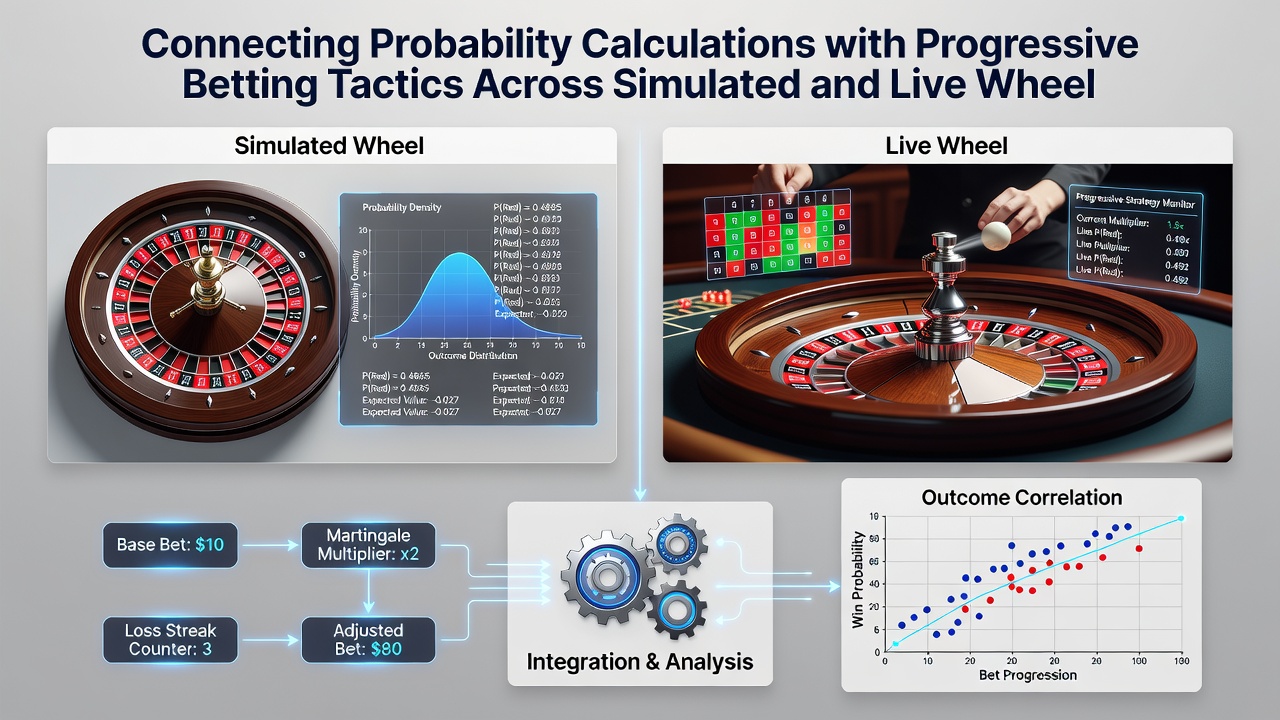
Live streams from regulated studios add visual confirmation of wheel integrity, yet the probability calculations remain unchanged because each spin maintains independence and equal pocket distribution. July 2026 regulatory updates from several European licensing bodies emphasized continued testing protocols for both RNG modules and physical equipment, reinforcing that progressive betting outcomes depend solely on bankroll depth and table maximums rather than delivery method.
Bankroll Management Within Licensed Boundaries
Table limits on licensed platforms cap the number of doublings possible in any progression, typically ranging from several hundred to several thousand units depending on the operator and jurisdiction, and these caps prevent theoretical recovery paths once a losing streak exceeds the ceiling. Session data collected across multiple sites indicates that users who apply flat betting alongside probability tracking maintain longer play durations compared with strict progression adherents who hit limits faster.
External testing laboratories verify that both simulated and live offerings meet the same payout accuracy standards, so probability models built for one environment transfer directly to the other without adjustment. Industry reports from the European Gaming and Betting Association highlight consistent house-edge disclosure requirements that help users model expected losses across different progression lengths before engaging either format.
Practical Application Across Formats
Users on licensed platforms frequently switch between simulated quick-spin modes and live dealer tables during the same session, applying identical probability tables and progression rules because the mathematical foundation stays constant. Software tools provided by some operators allow real-time calculation of required stake adjustments, displaying remaining progression steps before a table limit intervenes.
Academic studies published in gaming research journals demonstrate that no progression alters the fundamental independence of spins, and licensed environments enforce this reality through transparent rules and audit trails. Those who examine historical session logs from both simulated and live play confirm that variance produces streaks of varying length yet never shifts the overall expectation.
Conclusion
Connecting probability calculations with progressive betting tactics produces consistent results across simulated and live wheel experiences because the underlying odds and house edges remain fixed on all licensed platforms. Regulatory frameworks in multiple regions continue to require disclosure of these figures, enabling users to model outcomes accurately regardless of whether they engage digital interfaces or camera-streamed physical wheels. The mathematical limits of progression systems apply equally in both settings, bounded by table maximums and bankroll resources rather than delivery format.